Pixelated Lesbian Mixtape: Azian Nurudin’s Wicked Times
Pixelated Lesbian Mixtape: Azian Nurudin’s Wicked Times
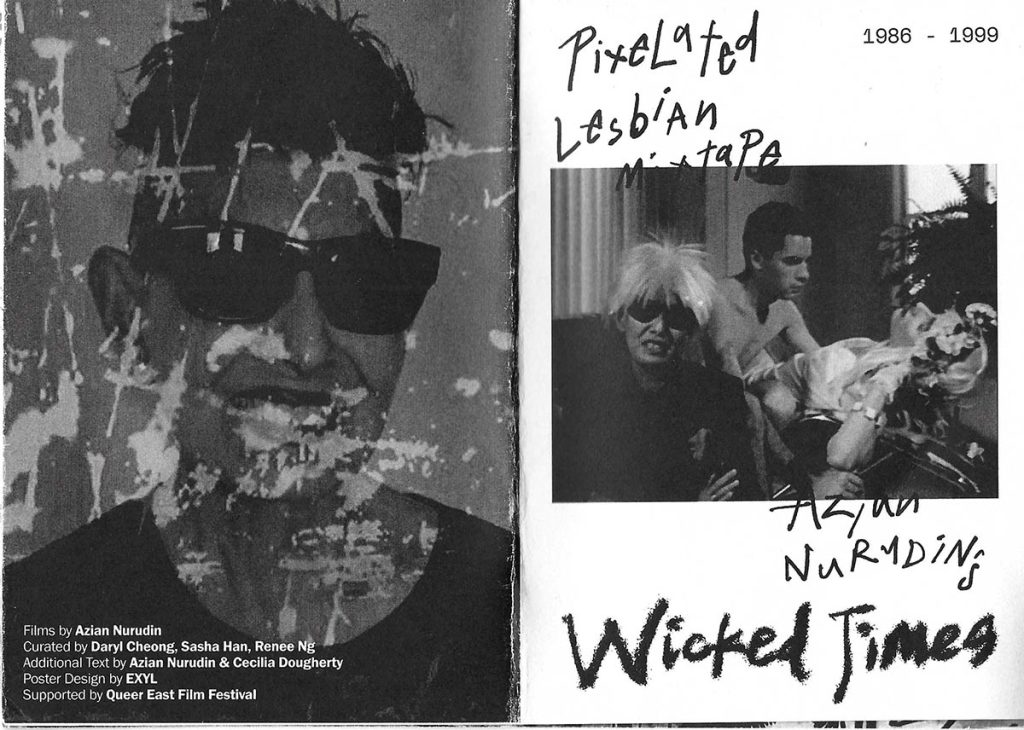
“Welcome, fellow wicked Queers!” Let me quote Daryl Cheong, Sasha Han, and Renee Ng, curators of the Queer East Film Festival, London, 2006, from their excellent Zine, created for the screening of works by Azian Nurudin:
“Sasha first encountered Azian Nurudin’s work while doing research on the PLX2000, a Fisher-Price black and white toy camera that recorded audiovisual material on cassette tapes. Between the diary videos of Sadie Benning to the sprawling feature-length video Joe-Joe (1993) by Cecilia Dougherty and Leslie Singer, the grainy, heavily pixelated image has since become synonymous with some of the most recognisable works by queer artists from the United States between the 1980s-1990s.
“At the San Francisco Art Institute, Azian worked alongside Dougherty and Singer in a “bratty pack” of women insurgent artists [italics mine], reflecting a tight-knit micro-community which shared equipment and was often able to act on impulse and swiftly execute her ideas.”
Congrats to Azian! And it’s nice to see how our work at SFAI and our pixel vision is regarded. Highly, basically. Thank you Daryl Cheong, Sasha Han, and Renee Ng!
Cecilia Dougherty and Leslie Singer as Joe Orton in our 1993 video, Joe-Joe.
“Queer Thanatography: Joe Orton’s Death and Afterlife” (excerpt) by Emma Parker, Arts, Media & Communication, University of Leicester, UK
Supporting Phelan’s* assertion that theatre has ‘a special relation to art as memorial’ (1997, 3), authors of screenplays and short fiction have created a different afterlife for Orton, one where he does not die or returns as a ghost. In the short film Joe-Joe (dir. Cecilia Dougherty and Leslie Singer, 1993), Halliwell is replaced with a second Orton, and the two Joes are both women (a couple), while Peggy Ramsay is a camp man. The film opposes lesbian invisibility, collapses gender binaries, wittily mocks the stereotypical association of homosexuality with narcissism, and poses a queer challenge to the conventions of time and space by transposing Orton from 1960s London to 1990s New York, indicated by a pile of books in the two Joes’ flat that includes Susan Faludi’s Backlash. Moreover, the film closes with sex rather than death. As Dougherty explains, in Joe-Joe, she and Singer ‘took up the story of playwright Joe Orton as seen in the film Prick Up Your Ears and reversed everything in it’.
*Peggy Phelan: Stressing that death can be social as well as physical, Peggy Phelan proposes that ‘Queers are queer because we recognise that we have survived our own deaths.’
2027 UK screening of Joe-Joe in discussion as part of a remembrance of Joe Orton and a memorial marking the 60th anniversary of his death. More postings about this coming up. Thank you, Emma Parker, for including my and Leslie’s own memorial piece on Joe Orton, Joe-Joe, in your excellent article.
I meant to make a quick animated GIF about the detention centers that are now all across the United States of America, but as I worked on it, the project, like the problem, was too big for a quick snarky comment to satisfy. Below is an animation that is more like a list of what I want to investigate for what will be a found footage film about ICE, DHS, and the gigantic lawlessness, cruelty and irresponsibility of the “immigration policy.” Money, money, money seems to be behind much of it. Corruption seems to be the vehicle for getting that money.
Topics for this project may include:
Money. Follow the money trail
Corporate “partners” – who what when where and how
Staffing detention centers and private police and incarceration forces
ICE recruitment, training, deployment, chain of command
Technologies and the companies who provide support for enforcement in the form of equipment and services, everything from clothing and masks to batons to vests to vehicles to ammo
Government oversight
Environmental costs of building camps in swamps, deserts, and other fragile ecosystems
Reported events and encounters with ICE agents by individuals, families, groups
Update October 2026
This project is complicated by my wanting to show interconnections between the corruption of the Trump presidency and everything it touches and a philosophical-activist approach to visualizing this corruption. I need to forget the philosophy and stick with the facts. They speak the loudest and clearest.
I have too many sources of information. I doom-scroll incessantly looking for more information and knowing the entire time that I am not getting any information at all. More research needed and I need to find a way to center the piece.
I realize that I have had a soundtrack in my head, which is steadily building itself into a theme for the entire piece. It’s a sonic theme that defines my relationship to the facts of our lives in America today. I need to get that soundtrack out of my head and into the editing space. I have started working on the keyboard. I need time and money. I need space. I’ll work with what I have at the moment.
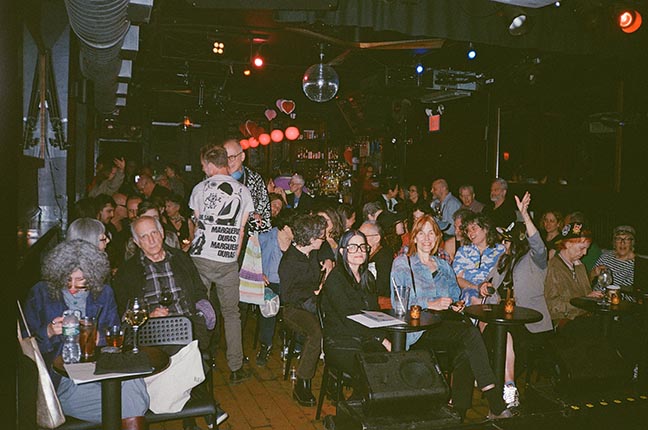
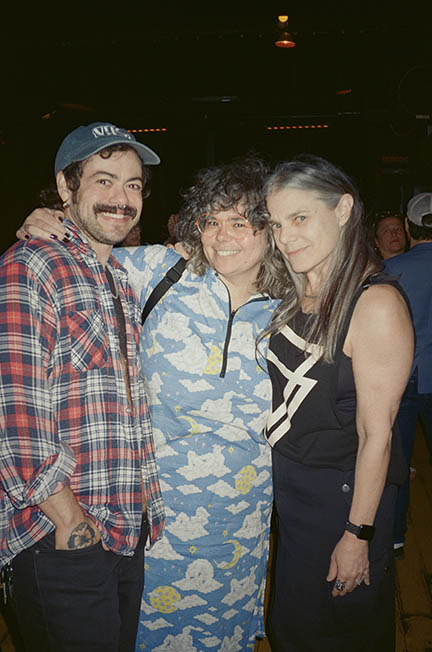
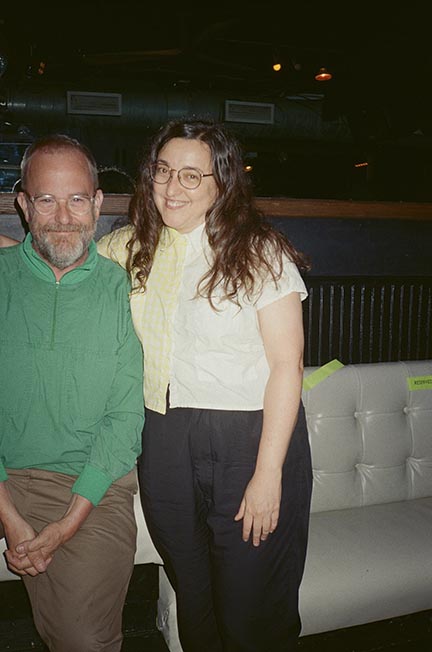
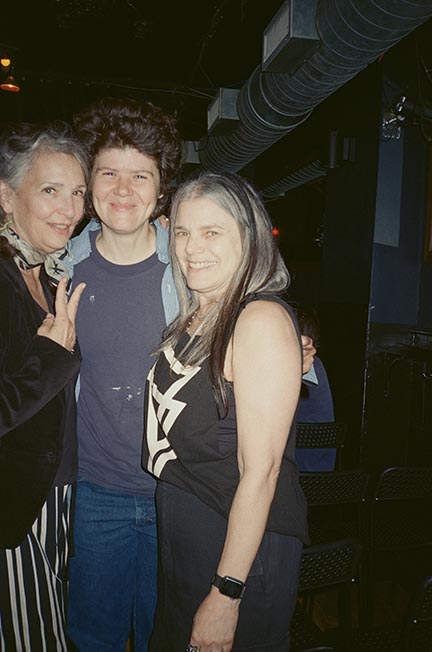
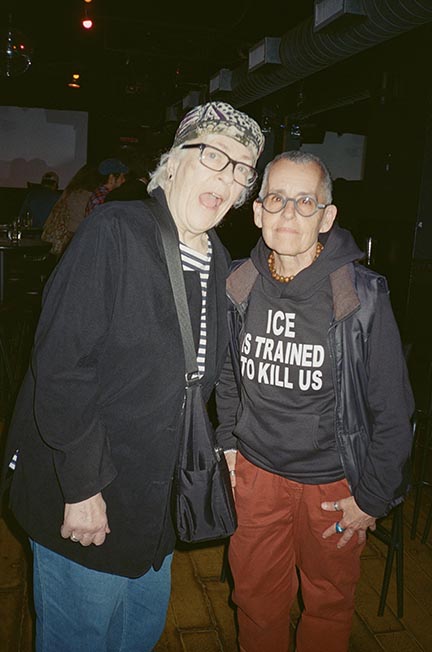
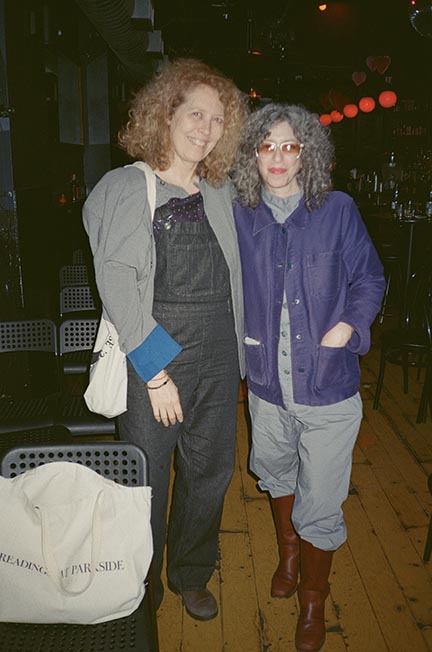
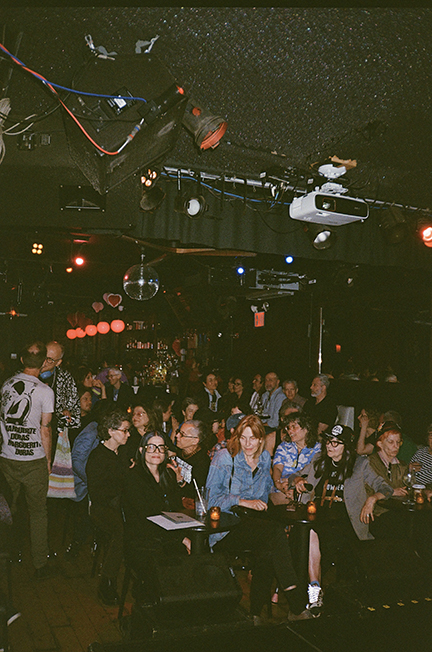
But this is a gorgeous crowd, at my May screening at Parkside Lounge. See my earlier post: Readings at Parkside. The party atmosphere at the Parkside set the mood for the screening of my writers series of videos, including video portraits of Joe Westmoreland, Laurie Weeks, Kevin Killian & Cedar Sigo, Leslie Scalapino, and Eileen Myles, covering a period from 1998 to 2018.
[click to enlarge]
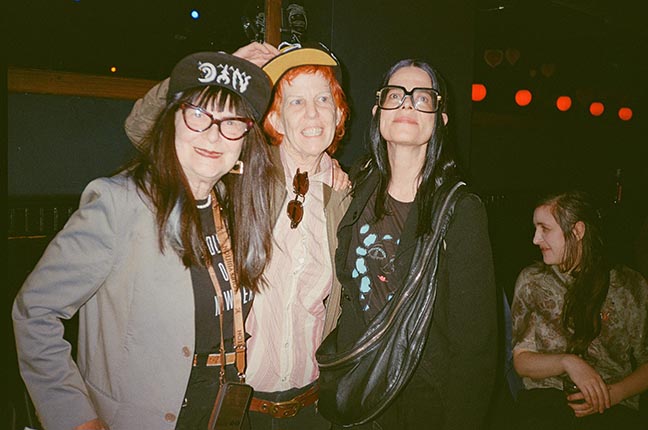
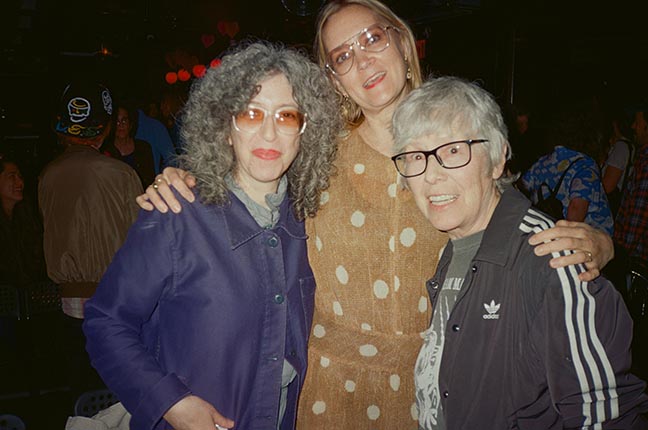
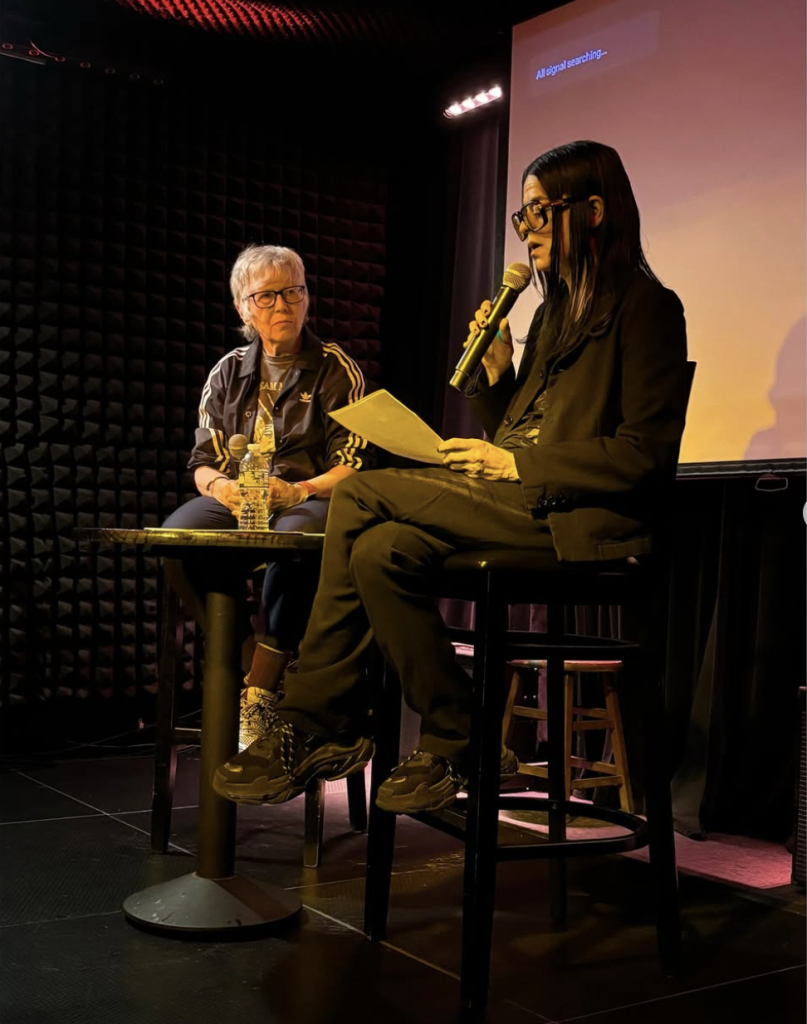
Crowd at the Parkside Lounge, NYC, screening of videos by Cecilia DoughertyMM Serra, Alice O’Malley, and Lia Gangitano Michelle Handleman and friendsLucy Sexton and friendSvetlana Kitto and friendJeanne Liotta, Cate Girodano, and Michelle HandlemanC Carr and friendAlystyre Julian and Lori ScaccoCrowd at the Parkside Lounge, NYC, screening of videos by Cecilia DoughertyLori Scacco, Ann Stephenson, and yours truly, Cecilia DoughertyCecilia Dougherty and Lia Gangitano in conversation after the screening of my videos
Azian Nurudin is someone I worked with in San Francisco in my grad student days and beyond. Her work was recently celebrated in the Queer East Film Festival 2026 with a screening of videos, some of which I worked on, and all of which I love and am indebted to for their absolute non-apologetic bravery and intelligence. Thanks, Azian!
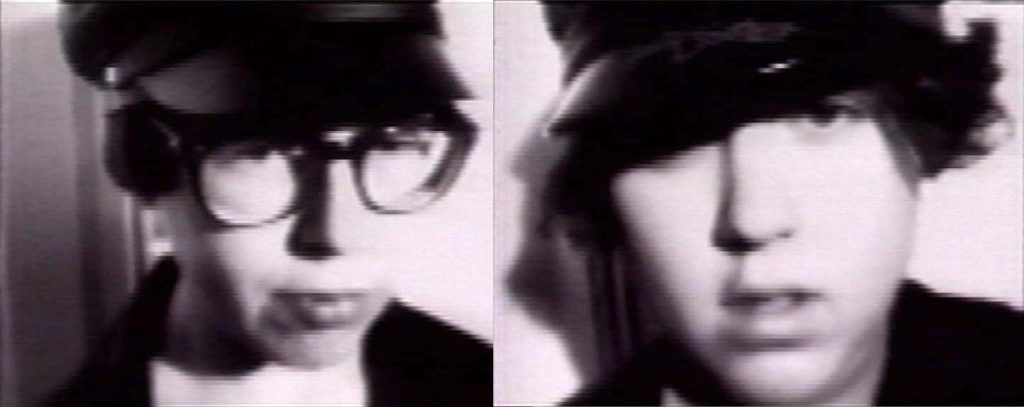
Video still from “Nancy’s Nightmare,” by Azian Nurudin, 1988
I wrote a brief essay about Azian’s work for the Queer East catalogue, which I have published below:
“I believe Azian Nurudin’s video work from the 1980s and ‘90s provides possible solutions to the global disasters wrought by late-stage patriarchy, such as those we are currently experiencing. Her content shifts the center of the then-current feminist discussions about colonialism, sex, justice, human rights – discussions that radiated ideology – to expressions of refusal and rage. Azian gives us the beauty of the experimental form in pieces such as Sinar Durjana (Wicked Radiance) (1991), and Bitter Strength: Sadistic Response Version (1992). In Malaysian Series 1-6, the performance of rage shifts the central argument vigorously from personal to geo-political, providing a visceral response to colonialism and the patriarchal death-wish.
“Those of us working in video together in San Francisco were creating a cohesive movement of feminist and queer experimental video without quite realizing the singularity of the moment. We shared equipment, cast members, and crew. Leslie Singer had a VHS camcorder that could turn out special effects and generate titles; Azian and I shared a Fisher-Price pixelvision camcorder that we purchased together for about $95. I did camera for Nancy’s Nightmare (1989) and What Do Pop Art, Pop Music, Pornography and Politics Have To Do With Real Life? (1990). And when I was making my own video Grapefruit (1989) about Yoko Ono, Azian agreed to play George Harrison. She insisted, however, on wearing sunglasses in every scene, weaving a new thread of visual humor into the piece.
“Azian’s work is raw as well as sophisticated, immediate as well as reflecting experience and contemplation. Process, community, performance in conjunction, clicking into place.”
Just a few photos from the May 2026 CSI Film Festival. The festival showed 13 films by students in the Video Editing, Cinematography, Non-Linear, Thesis, and Workshop classes. The work at this year’s festival showed a lot of ingenuity, hard work, thoughtfulness, and some crazy (yet well-produced) fun. Many of my students in this festival – happy to have these great photos of them!
CSI Film Festival Director Mitchell LovellFestival winners and emerging filmmakers: Mia Sinodinos and Samuel Schell, with Media Culture Dept. faculty Emma Johnson and Film Festival Director Mitchell Lovell, behind the podiumCarmine Mazza and Louis Yeomas, CSI Film Festival award winners and emerging filmmakersEmerging filmmakers and CSI Film Festival award winners Emm Wilson and Arianna GaytanFestival Director Mitchell Lovell with the participating student filmmakers at CSI Film Festival. Congratulations, everyone!
317 E. Houston St., New York City, Tuesday, May 5, 7:30 PM, doors open at 7 PM.
Screening of my Writers Series of intimate video portraits. The works include Joe, 2018, with Joe Westmoreland; Kevin and Cedar, 2002, with Kevin Killian and Cedar Sigo; Eileen, 2000, with Eileen Myles; Lesie, 1998, with Leslie Scalapino; and Laurie, 1998, with Laurie Weeks. Total running time is about 45 minutes. I love these writers!
Afterwards, I’m discussing the videos with Lia Gangitano, excellent curator and gallerist at Participant Inc. in NYC, who has been showing my work since 1998, with a several-day screening event at Threadwaxing Space in lower Manhattan.
Lia Gangitano, photo by A. Steiner
Ann Stephenson, who curates the Readings at Parkside series was generous enough to ask about the Writers Series. This is the first time they will have all been screen together. Thank you, Ann!
The Parkside Lounge is a neighborhood bar with music and events venue in the back room. It has a friendly neighborhood vibe. People of all ages and stripes enjoying a pint, enjoying each other’s company, attending readings by contemporary greats, and now, there’s a video screening! I look forward to seeing you there.
Tuesday, April 15, 2025 at 7pmLight Industry, 361 Stagg Street, Suite 407, Brooklyn
German Song, Sadie Benning, 1995, digital projection, 6 mins An Epic: Falling Between the Cracks, Nancy Andrews, 1995, digital projection, 6 minsTrue Confessions of an Artist, Kirsten Stoltmann, 1994, digital projection, 5 mins The Fight, Jeanine Oleson, 1995, digital projection, 3 mins Sapphire and the Slave Girl, L. Franklin Gilliam, 1995, digital projection, 17 mins I, Bear, Hendl Helen Mirra, 1995, digital projection, 6 mins Dear Mom, Tammy Rae Carland, 1995, digital projection, 3 mins aletheia, Tran T. Kim-Trang, 1992, digital projection, 16 mins Chronicles of a Lying Spirit (by Kelly Gabron), Cauleen Smith, 1992, 16mm, 6 mins The Girl’s Nervy, Jennifer Reeves, 1995, 16mm, 5 mins My Failure to Assimilate, Cecilia Dougherty, 1995, digital projection, 20 mins
Video still from My Failure to Assimilate, by Cecilia Dougherty, 1995
The program: In 1995, after the rise of Third Wave feminism but before the social and political realignments of the internet, artistElisabeth Subrin organized a screening of films and videos entitled No More Sweets For You. The program firstshowed at the Randolph Street Gallery in Chicago, then toured to Hallwalls in Buffalo and the MIX festival in NewYork City. Though each lineup differed, many of the core offerings were by American women who, like Subrinherself, were under 30. Seen today, it reveals a rich (and still, in many ways, underappreciated) vein of feministexperimental cinema at the end of the 20th century.
The works concern thwarted connections and, as Subrin put it at the time, “the fantasies, trauma andschizophrenia of solo-ness,” but the program also suggests an intensely collaborative milieu. Its artists wereassociated in numerous ways—as colleagues or lovers or friends—and traces of these relationships can be seenin the credits: Tammy Rae Carland appears as an interviewee in Cecilia Dougherty’s video, Subrin and KirstenStoltmann worked on Franklin Gilliam’s tape; and in turn Gilliam, Stoltmann, and Sadie Benning were involvedwith the production of Subrin’s own Swallow, completed that same year and featured in the original program.
Unlike boomer feminist celebrations of community and sisterhood, the screening is haunted by the specter offailure and figures of isolation. Consider the wandering latchkey kid of Benning’s German Song, the Nauman-eque artiste depicted in Kirsten Stoltmann’s Confessions, or the mop-haired child subject of Hendl Helen Mirra’s I,Bear. Nowhere are film or video employed as simple tools of communication; both celluloid and electronic imagesare likewise approached as malleable, tactile forms, made visually complex through multiple layers ofremediation: documents collaged and animated, videos re-taped off monitors, images scratched, frozen, andpainted-over. The viewer can sense lone psyches wrestling with the crises of their day, in the cellular isolation of alate-night editing suite. Identities are metabolized by, and drift between, a range of audiovisual formats andprocesses, including Super-8, manually-edited 16mm, analog video, Pixelvision, and digital effects.
With a typically Gen-X dialectical ambivalence, these artists collectively argue that isolation can simultaneouslyfoster both mental destabilization and social resistance. “In an era of corporate grunge, queer commodification,empowerment politics and right-wing cyborgs,” Subrin asks in her original program notes, “how do theunassimilated survive without being smashed, named or forced to participate?” The answer provided by No MoreSweets for You: it’s personal, it’s deep, and it’s complicated.