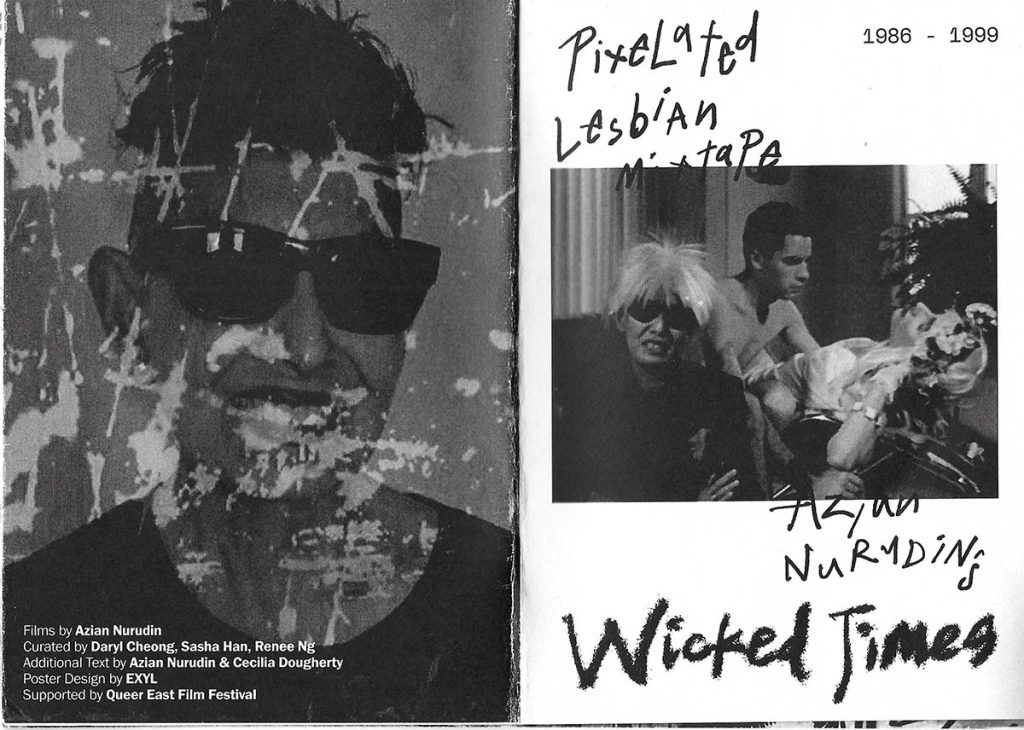
Pixelated Lesbian Mixtape: Azian Nurudin’s Wicked Times
Pixelated Lesbian Mixtape: Azian Nurudin’s Wicked Times
“Welcome, fellow wicked Queers!” Let me quote Daryl Cheong, Sasha Han, and Renee Ng, curators of the Queer East Film Festival, London, 2006, from their excellent Zine, created for the screening of works by Azian Nurudin:
“Sasha first encountered Azian Nurudin’s work while doing research on the PLX2000, a Fisher-Price black and white toy camera that recorded audiovisual material on cassette tapes. Between the diary videos of Sadie Benning to the sprawling feature-length video Joe-Joe (1993) by Cecilia Dougherty and Leslie Singer, the grainy, heavily pixelated image has since become synonymous with some of the most recognisable works by queer artists from the United States between the 1980s-1990s.
“At the San Francisco Art Institute, Azian worked alongside Dougherty and Singer in a “bratty pack” of women insurgent artists [italics mine], reflecting a tight-knit micro-community which shared equipment and was often able to act on impulse and swiftly execute her ideas.”
Congrats to Azian! And it’s nice to see how our work at SFAI and our pixel vision is regarded. Highly, basically. Thank you Daryl Cheong, Sasha Han, and Renee Ng!
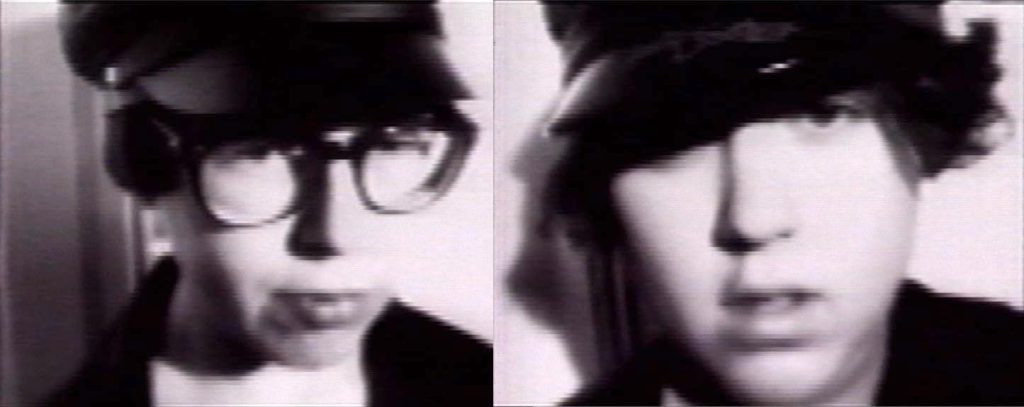
Cecilia Dougherty and Leslie Singer as Joe Orton in our 1993 video, Joe-Joe.
“Queer Thanatography: Joe Orton’s Death and Afterlife” (excerpt) by Emma Parker, Arts, Media & Communication, University of Leicester, UK
Supporting Phelan’s* assertion that theatre has ‘a special relation to art as memorial’ (1997, 3), authors of screenplays and short fiction have created a different afterlife for Orton, one where he does not die or returns as a ghost. In the short film Joe-Joe (dir. Cecilia Dougherty and Leslie Singer, 1993), Halliwell is replaced with a second Orton, and the two Joes are both women (a couple), while Peggy Ramsay is a camp man. The film opposes lesbian invisibility, collapses gender binaries, wittily mocks the stereotypical association of homosexuality with narcissism, and poses a queer challenge to the conventions of time and space by transposing Orton from 1960s London to 1990s New York, indicated by a pile of books in the two Joes’ flat that includes Susan Faludi’s Backlash. Moreover, the film closes with sex rather than death. As Dougherty explains, in Joe-Joe, she and Singer ‘took up the story of playwright Joe Orton as seen in the film Prick Up Your Ears and reversed everything in it’.
*Peggy Phelan: Stressing that death can be social as well as physical, Peggy Phelan proposes that ‘Queers are queer because we recognise that we have survived our own deaths.’
2027 UK screening of Joe-Joe in discussion as part of a remembrance of Joe Orton and a memorial marking the 60th anniversary of his death. More postings about this coming up. Thank you, Emma Parker, for including my and Leslie’s own memorial piece on Joe Orton, Joe-Joe, in your excellent article.
Shanidar, Safe Return my interactive story, now being hosted by Participant After Dark, the ONLINE venue for Participant Inc. Gallery, NY, has been extended until July 14, 2024. Shanidar is curated by Itziar Barrios.
Timeline: 40,000 years BCE. In Shanidar, Safe Return, a band of Neanderthals and their Cro-Magnon companions ncluding Haizea, Esti, Oihana, Eneko and Uda, make an epic journey from what is now southern France to a place called Shanidar, a large cave in Iraqi Kurdistan, situated along tributaries of the Tigris and Euphrates Rivers. Along the way they learn that humanity is blessed by its heritage of mixing and sharing everything, including genes. As in all things evolutionary – including food, shelter, community and love – it’s a matter of survival. Their shaman’s lion guide keeps them on the right path.
While writing Shanidar, I did extensive research into Paleolithic Eurasia, the human species that lived there, their probable habits, foods and methods of travel, as well as their music and art. Many of the graphics are my versions of specific Paleolithic artworks, some of which I have seen in person, but many of which I have copied from the drawings by André Leroi-Gourhan’s in his 1993 book Gesture and Speech. I used other sources as well including photos and drawings in works by Jean Clottes, Marjia Gimbutas, and Max Rafael. I composed the music and recorded effects for the soundtrack and borrowed, with credits, sound effects and music from other sources. Shanidar is a work of speculative fiction backed up by a lot of research into the deep past. Who were we?
What is Interactive Fiction, and How Can You Experience Shanidar?
Shanidar is entirely online, a work of cyber-art, interactive fiction, a computer-based experience. It’s similar to playing a game, where you go to the link provided, https://participantafterdark.art/, view the video intro, and enter the story by clicking on the PLAY button.
Writers create all kinds of interactive stories – it’s a very active culture/sub-culture – using a variety of software platforms as a base, then adding text, images, videos, and a sound track to bring the reader/player closer to the action, or possibly even inside the action.
From Wikipedia:
Interactive fiction, often abbreviated IF, is software simulating environments in which players use text commands to control characters and influence the environment. Works in this form can be understood as literary narratives, either in the form of Interactive narratives or Interactive narrations.
What is Interactive Fiction? It’s a way to tell a story by having the reader, or visitor to the story site, “play” the story by making choices about what part of the story to go to next – the reader can navigate forwards and backwards throughout the story. There is no directly linear way to experience Interactive Fiction, and much of it has not only text – the story – but also graphics, animation, and sound. It provides a rich, inviting and immersive pathway into narratives.
Trailer for Shanidar, Safe Return, launched Oct. 23, 2023
Shanidar, Safe Return is an interactive story that places a young Neanderthal woman named Haizea in the center of a community’s struggle for survival, as the Cro-Magnins (Homo sapiens) migrate to their once-peaceful territories. Haizea and her band of mixed – Neanderthal and Cro-Magnin – travelers must walk the distance from danger in what is now southern France to safety in their old refuge in Iraqi Kurdistan, a place called Shanidar. They meet a group of Denisovans on the way, and receive guidance from the old H. heidelbergensis shaman, Bihotz.
The work of Cecilia Dougherty explores the nature of queer women’s relationships to one another, society, and the everyday as well as providing a feminist analysis of lesbian sexuality, psychologies, and intimacies inside a culture that is, at best, indifferent and at worst, hostile. She often uses methodologies borrowed from documentary and biography to map contemporary realities over pop-historical icons, creating art that deals with nostalgia, popular culture, and the social realm.
Looking to Dougherty’s lasting legacy, we are pleased to present the lecture “Make Believe, It’s Just Like the Truth Clings to It: In Conversation with the Work of Cecilia Dougherty.” The event is a conversation between Cecilia Doughery and Amanda Mendelsohn of the Video Data Bank at the School of the Art Institute of Chicago.