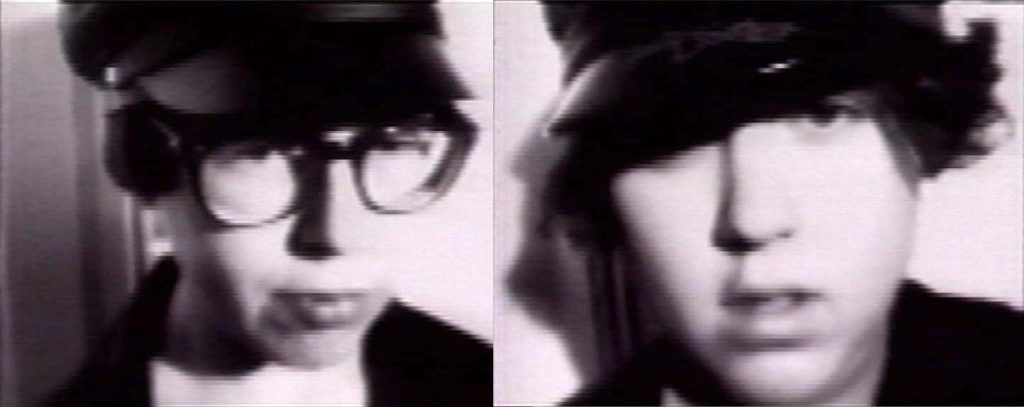
“Queer Thanatography: Joe Orton’s Death and Afterlife” (excerpt)
by Emma Parker, Arts, Media & Communication, University of Leicester, UK
Supporting Phelan’s* assertion that theatre has ‘a special relation to art as memorial’ (1997, 3), authors of screenplays and short fiction have created a different afterlife for Orton, one where he does not die or returns as a ghost. In the short film Joe-Joe (dir. Cecilia Dougherty and Leslie Singer, 1993), Halliwell is replaced with a second Orton, and the two Joes are both women (a couple), while Peggy Ramsay is a camp man. The film opposes lesbian invisibility, collapses gender binaries, wittily mocks the stereotypical association of homosexuality with narcissism, and poses a queer challenge to the conventions of time and space by transposing Orton from 1960s London to 1990s New York, indicated by a pile of books in the two Joes’ flat that includes Susan Faludi’s Backlash. Moreover, the film closes with sex rather than death. As Dougherty explains, in Joe-Joe, she and Singer ‘took up the story of playwright Joe Orton as seen in the film Prick Up Your Ears and reversed everything in it’.
*Peggy Phelan: Stressing that death can be social as well as physical, Peggy Phelan proposes that ‘Queers are queer because we recognise that we have survived our own deaths.’
Emma Parker’s full article can be found here: https://www.tandfonline.com/doi/full/10.1080/14484528.2026.2705216
2027 UK screening of Joe-Joe in discussion as part of a remembrance of Joe Orton and a memorial marking the 60th anniversary of his death. More postings about this coming up. Thank you, Emma Parker, for including my and Leslie’s own memorial piece on Joe Orton, Joe-Joe, in your excellent article.