Bratty Pack of Women Insurgent Artists (!)

Right on.

Zine cover for Azian Nurudin's show in London
Pixelated Lesbian Mixtape: Azian Nurudin’s Wicked Times
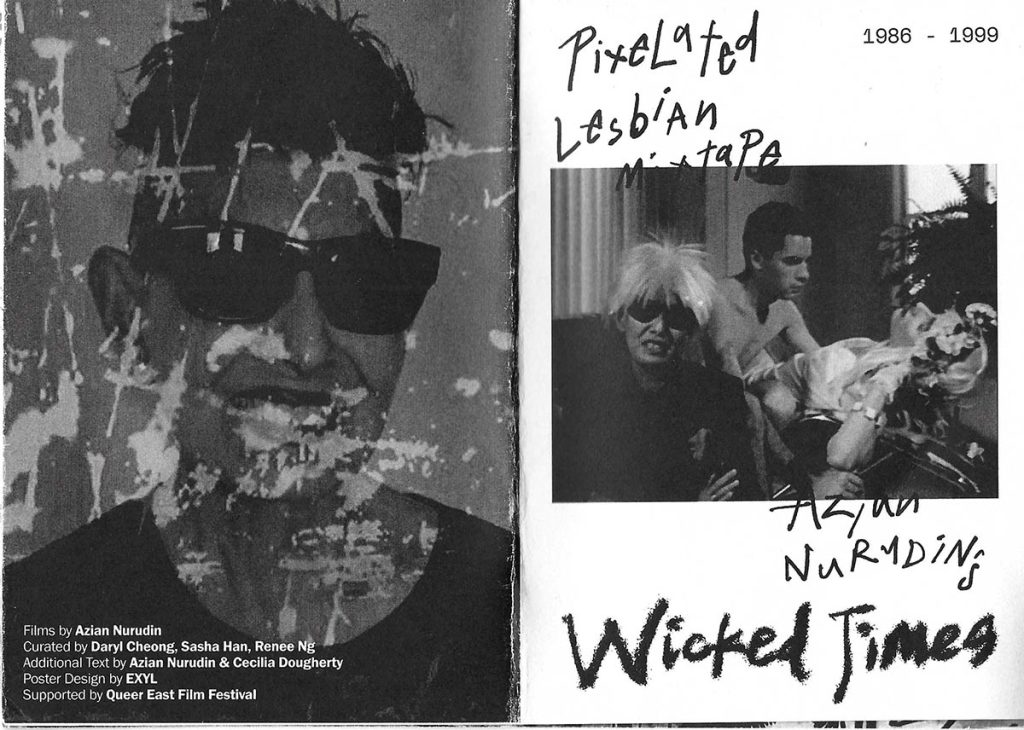
“Welcome, fellow wicked Queers!” Let me quote Daryl Cheong, Sasha Han, and Renee Ng, curators of the Queer East Film Festival, London, 2006, from their excellent Zine, created for the screening of works by Azian Nurudin:

“Sasha first encountered Azian Nurudin’s work while doing research on the PLX2000, a Fisher-Price black and white toy camera that recorded audiovisual material on cassette tapes. Between the diary videos of Sadie Benning to the sprawling feature-length video Joe-Joe (1993) by Cecilia Dougherty and Leslie Singer, the grainy, heavily pixelated image has since become synonymous with some of the most recognisable works by queer artists from the United States between the 1980s-1990s.

“At the San Francisco Art Institute, Azian worked alongside Dougherty and Singer in a “bratty pack” of women insurgent artists [italics mine], reflecting a tight-knit micro-community which shared equipment and was often able to act on impulse and swiftly execute her ideas.”

Congrats to Azian! And it’s nice to see how our work at SFAI and our pixel vision is regarded. Highly, basically. Thank you Daryl Cheong, Sasha Han, and Renee Ng!

 Make Believe, It’s Just Like the Truth Clings to It: In Conversation with the Work of Cecilia Dougherty

 New writing on the work of Cecilia Dougherty

by Amanda Mendelsohn

Cecilia Dougherty got her start as a video artist in an unconventional way, fitting for her experimental body of work. As an undergraduate at the University of California, Berkeley, Dougherty was a painter. However, in her last semester of college, she took a video production class, changing the course of her education and career permanently. Dougherty fell in love with video art, and was inspired to singularly pursue the medium. Using the one video she made for that class,

Dougherty applied to the Performance and Video MFA program at the San Francisco Institute of Art in the late ‘80s, and the rest was history. Prior to this, she had very little knowledge about the history of video art, let alone the process of making it. Additionally, during this time period Dougherty was grappling with her identity as a lesbian in a heteronormative society, working to “find an adequate expression of it as a place to exist inside the social realm sexually, politically, and personally.”

She was simultaneously breaking ground in new territory as an artist, and that territory for lesbian expression was in no way near established for video art. Combining this aspect of her life with her practice, Dougherty created the following works included in this program: The Drama of the Gifted Child (1992), My Failure to Assimilate (1995), The dream and the waking (1997), and Gone (2001).

video still, Gone, by Cecilia Dougherty, 2001

Read the entire article here

(All quotes attributed to Cecilia Dougherty from the author’s interview with Dougherty on July 15th, 2022.)

See and read PDF of this essay here.